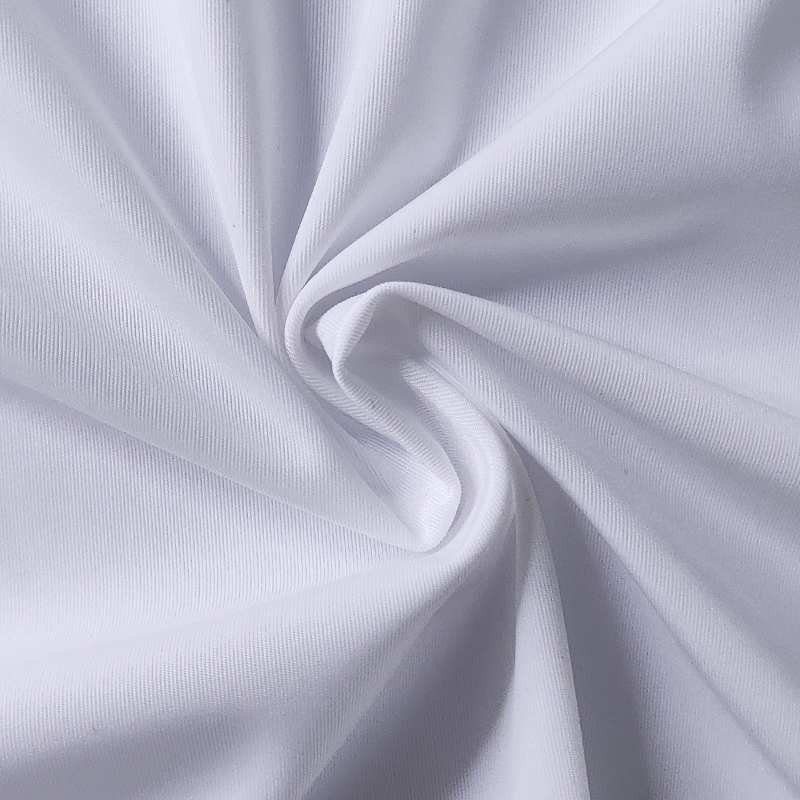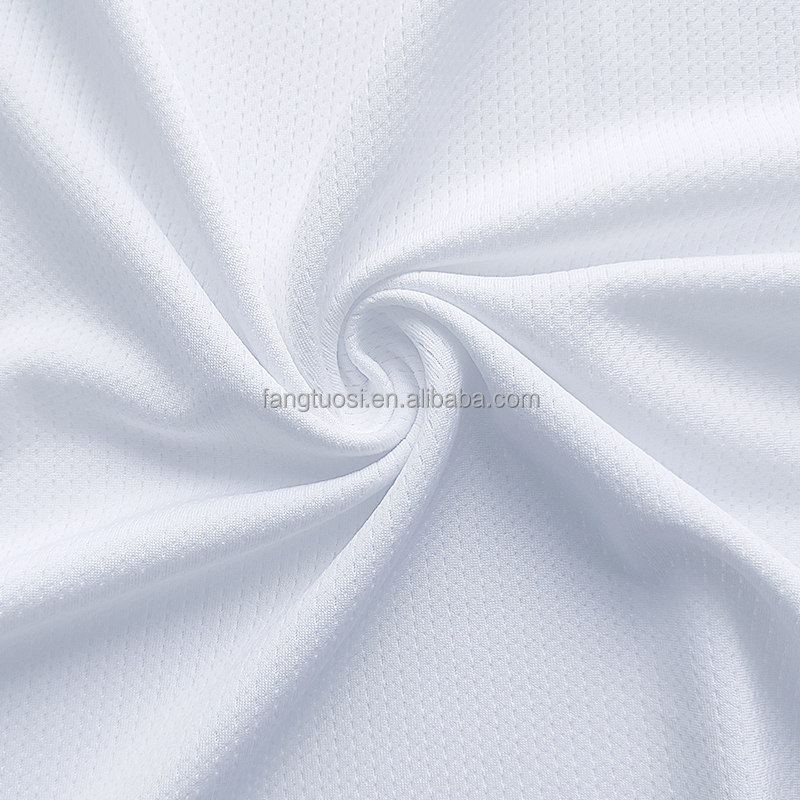
Basketball jersey fabric has to do more than feel lightweight or breathable. During a game, the garment is exposed to repeated sprinting, jumping, shoulder and torso movement, heavy perspiration and physical contact. At the same time, team jerseys often need a stable surface for numbers, logos, gradients and sublimated graphics.
That is why there is no single universal basketball jersey material. Polyester mesh, bird-eye structures, interlock, honeycomb and engineered jacquard knits can all be used, but they solve different performance and design problems.
East Xinwei's current team-jersey fabric range includes polyester mesh, bird-eye, double-knit interlock, honeycomb, cube mesh and engineered jacquard structures for basketball, football and related sportswear applications.
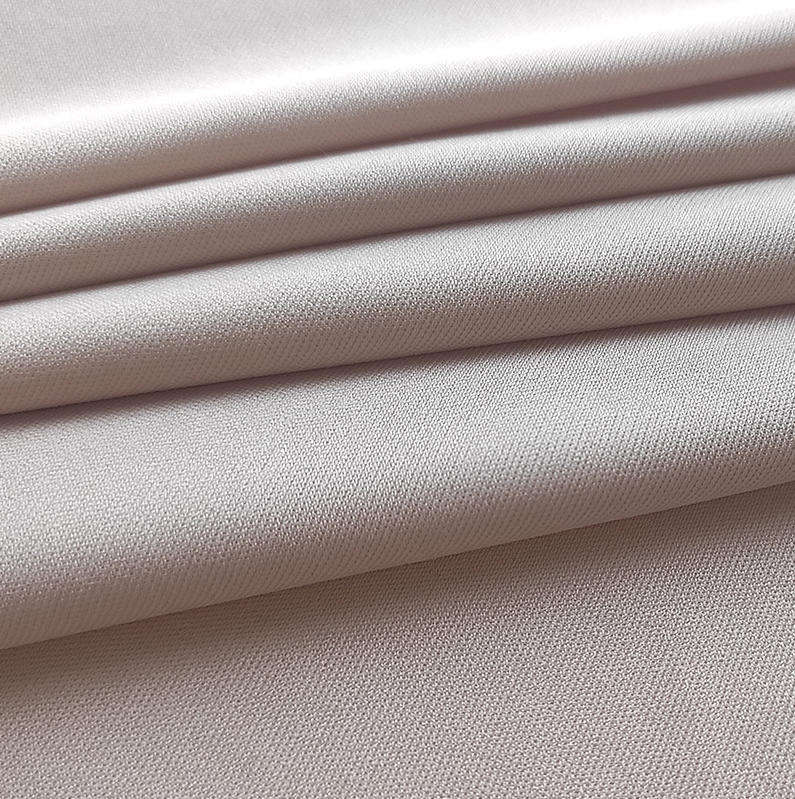
Breathability matters during high-intensity play, but maximizing airflow alone does not automatically create a better jersey. A very open fabric may ventilate effectively while providing less surface coverage or a different printing result than a denser knit.
A useful basketball jersey fabric has to balance several requirements:
Thermal and moisture comfort: Airflow, moisture transport and drying behavior need to work together during repeated high-intensity movement. Research on sports textiles shows that fabric construction, thickness and other physical properties influence thermal and moisture-management performance.
Weight and mobility: The garment should move easily without creating unnecessary bulk during running, jumping and upper-body rotation.
Durability and stability: Contact, repeated stretching and laundering mean the structure must maintain useful shape and surface integrity.
Decoration compatibility: Team colors, numbers, names and graphics require a fabric surface suited to the intended printing method.
The best basketball jersey fabric is therefore not simply the most breathable option. It must balance ventilation, moisture transport, weight, durability and decoration requirements.
Mesh and interlock illustrate how two polyester knits can behave differently even when their fiber composition is similar.
| Feature | Mesh Knit | Interlock Knit |
|---|---|---|
| Air permeability | Generally higher | Moderate |
| Surface coverage | More open | Denser |
| Structure | Lightweight / ventilated | Stable / smooth |
| Printing surface | Depends on opening size | Usually more continuous |
| Typical role | Ventilation-focused areas | Structured body or graphic panels |
Mesh fabrics contain more obvious openings or porous structures that can encourage airflow. East Xinwei currently offers vertical mesh, bird-eye mesh, honeycomb and other open constructions within its team-jersey range.
Interlock uses a denser double-knit construction. East Xinwei's polyester double-knit interlock for basketball jerseys, for example, is offered as a more substantial 220–280 gsm fabric with wicking and quick-dry characteristics.
Neither structure is universally superior. The useful question is whether a jersey panel needs greater ventilation, greater surface stability or a balance of both.
The term “mesh” covers many different structures.
Bird-eye fabric uses small, regularly distributed eyelet-like openings. East Xinwei positions its polyester bird-eye mesh for high-energy sports applications where airflow, moisture management and low weight are important.
Honeycomb mesh creates a more visible geometric structure. Its larger visual texture can become part of the jersey design itself while still creating open areas for ventilation. East Xinwei's honeycomb sports fabric uses a hexagonal structure intended to increase airflow during intensive activity.
Engineered jacquard takes the idea further. Rather than relying on one repeated opening across the entire fabric, knitting patterns can create different textures or ventilation effects as part of the fabric construction. East Xinwei currently offers a 100% polyester engineered jacquard mesh specifically positioned for basketball and soccer jerseys.
So basketball jersey fabric types should not be grouped simply into “mesh” and “non-mesh.” Hole geometry, knit density and engineered patterning can create very different results.
Polyester is widely used in basketball jerseys because it absorbs relatively little moisture into the fiber compared with more hydrophilic materials. But using 100% polyester does not automatically guarantee strong moisture-management performance.
The yarn construction, knit density, pore structure, surface area and finishing process all influence how perspiration moves through a garment.
East Xinwei's own technical guidance makes this distinction clear: polyester fiber alone does not create effective wicking, while mesh, bird-eye, honeycomb, jacquard and engineered jersey structures can influence moisture pathways and airflow.
This explains why two jerseys labelled “100% polyester” can feel noticeably different during play. One may use a dense plain structure, while another creates more capillary pathways or ventilation zones through its knitting pattern.
Fiber content tells you what the textile is made from; fabric engineering helps determine how that material behaves.
Basketball jerseys are highly visual garments. Team colors, player numbers, sponsor marks and graphic patterns often cover large portions of the surface, making print performance part of fabric selection.
Sublimation is particularly compatible with polyester because the process can transfer color into polyester-based material rather than simply placing a heavy graphic layer on top. East Xinwei currently lists polyester and polyester-spandex sports mesh fabrics specifically for sublimation in basketball, soccer and other jerseys.
However, knit structure still matters. A very open mesh can visually interrupt fine graphic details, while a smoother interlock may provide a more continuous surface. Fabric weight, opacity, surface uniformity and heat stability also influence how the finished jersey looks.
This means a brand designing an all-over graphic jersey may prioritize a different construction from one using large ventilation panels with relatively simple decoration.
A basketball jersey does not necessarily need the same structure from neckline to hem. Different parts of the garment perform different jobs, which creates an opportunity for zoned fabric engineering.
High-heat or high-sweat areas can use more open mesh or engineered ventilation structures to support airflow.
Front and back graphic zones may benefit from smoother or more stable surfaces where numbers, logos and sublimated artwork need visual clarity.
Areas exposed to repeated friction or stretching can use stronger knit structures to improve dimensional stability.
Decorative zones can use jacquard structures to introduce texture or visual identity directly through knitting rather than printing alone.
East Xinwei's basketball and team jersey fabric range already spans mesh, interlock, honeycomb, bird-eye and engineered jacquard structures, providing the building blocks for this type of differentiated jersey construction.
The result is a more useful way to think about jersey design: not “Which one fabric is best?” but “Which structure should perform each job?”
Most modern basketball jersey fabric is polyester-based, but polyester content alone cannot explain performance.
Mesh can increase ventilation, interlock provides a denser and more stable surface, while bird-eye, honeycomb and engineered jacquard structures introduce different combinations of airflow, texture and visual design. Moisture management also depends on yarn and knit construction, while sublimation introduces another set of surface requirements.
The strongest jersey designs therefore treat fabric as an engineered system. Fiber, knit structure, weight, moisture behavior, printing and panel placement all need to work together on court.
Polyester is widely used, with structures including mesh, bird-eye, interlock, honeycomb and jacquard knits.
Yes. Mesh can support airflow and lightweight comfort, although opening size and structure should also suit durability and decoration requirements.
Mesh is generally more open and ventilation-focused, while interlock provides a denser, smoother and more stable knitted surface.
Polyester offers low moisture absorption, durability and strong compatibility with performance knitting and sublimation processes.
Polyester-based fabrics are commonly used, but surface smoothness, opacity and knit structure should be matched to the intended graphic design.
Yes. Zoned construction can combine ventilation-focused mesh, stable graphic areas and stronger structures according to the demands of each garment zone.