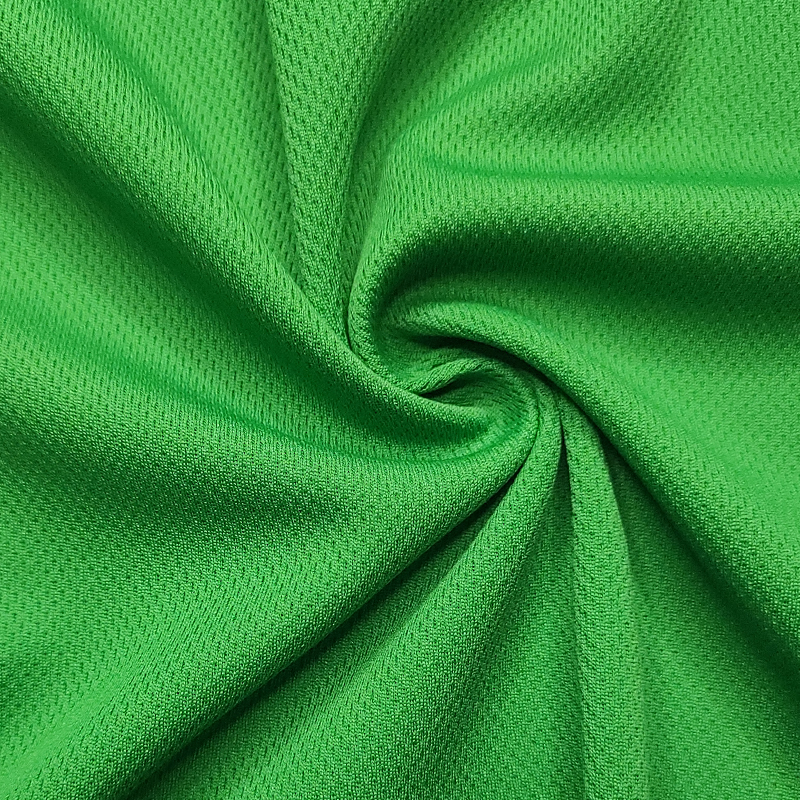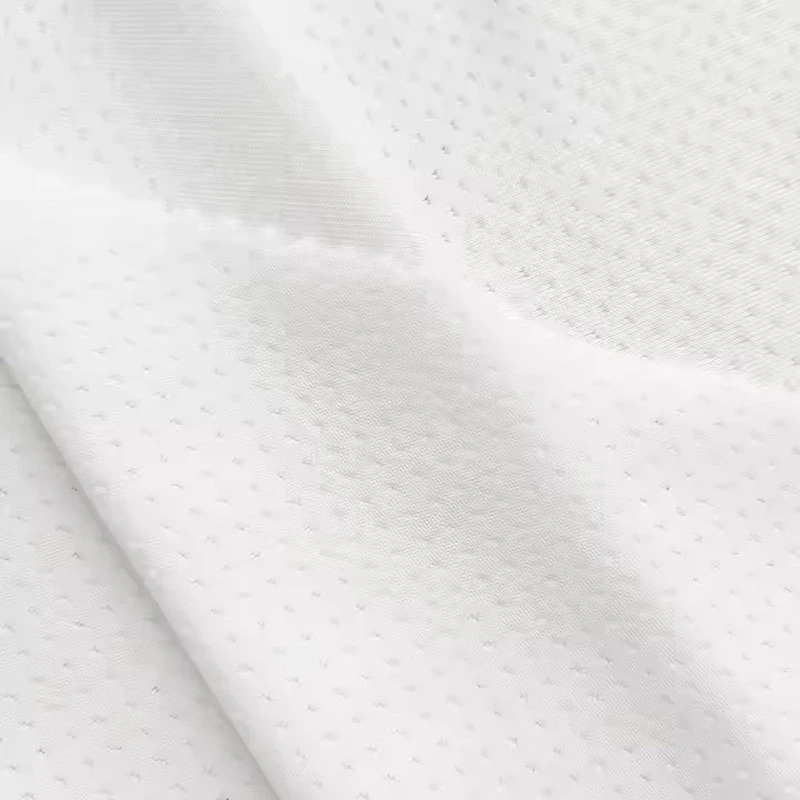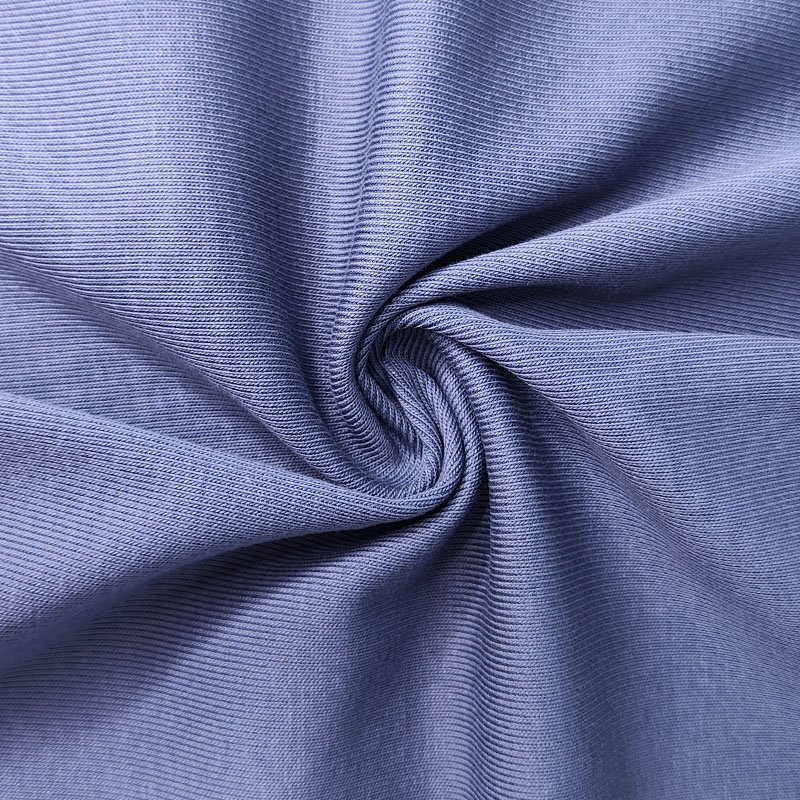
In the competitive sportswear market, fabric is the product. While most brands still rely on flat knits with surface printing for their quick-dry T-shirts, jacquard knit fabric is rapidly becoming the material of choice for premium activewear lines.
The difference is structural, not cosmetic. Jacquard patterns are woven into the fabric during knitting — not printed on top afterward. This means the texture, the ventilation zones, and the visual identity are all one inseparable system. For procurement managers and brand owners, this translates into three hard deliverables: permanent pattern integrity, measurable breathability gains, and a tactile premium that commands higher retail margins.
This guide covers everything a B2B buyer needs to evaluate jacquard knit fabrics for sportswear: the knit-vs-woven distinction, the performance mechanics, the fiber composition decision matrix, functional finishing compatibility, and the procurement specifics — MOQ, lead times, and custom development.
The first misconception to clear: sportswear jacquard is knitted, not woven. Woven jacquard — think brocade upholstery or damask curtains — is dense, structured, and traps heat. Knit jacquard, produced on computerized circular knitting machines, is lightweight, breathable, and stretches with the body.
For a sportswear buyer, this distinction is everything. You are not buying furnishing fabric adapted for clothing; you are buying a performance knit engineered with integrated texture.
Attribute | Printed Fabric | Jacquard Knit Fabric |
Pattern Formation | Surface coating applied after knitting | Yarn interlacing during knitting — pattern is the fabric structure |
Breathability | Ink/paste may clog fiber pores, reducing airflow | Raised-recessed structure creates micro-ventilation cavities |
Durability | Fades, cracks, peels after 20–50 washes | Pattern lasts the full lifecycle of the garment — never separates |
Hand Feel | Flat, uniform surface | Three-dimensional texture with tactile depth |
Brand Positioning | Mass-market, commodity-level | Premium, differentiated, higher perceived value |
Bottom line for buyers: Jacquard eliminates the single most common warranty claim on printed activewear — pattern degradation. This alone can justify the fabric upgrade in your cost model.
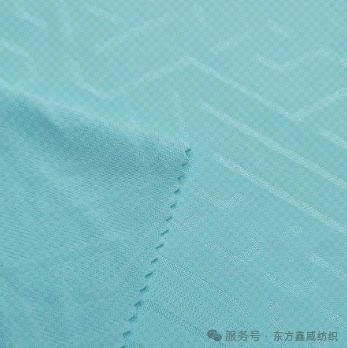
The raised-and-recessed surface of jacquard knit creates thousands of micro-air cavities between the fabric and the skin. Unlike a flat knit that sits flush against the body, jacquard holds the fabric slightly off the skin — even when the wearer is sweating heavily.
Measurable impact: Air permeability tests on our 150gsm jacquard knit show 30–50% higher airflow than a flat single jersey at the same weight. For brands marketing to runners, gym-goers, and outdoor athletes, this is a quantifiable performance claim.
Jacquard texture grooves function as built-in capillary channels. Sweat is guided along the textured pathways and spread across a larger surface area for faster evaporation. This is a physical mechanism — not a chemical coating.
Why this matters for procurement: Chemical moisture-wicking finishes degrade with washing. Structural moisture channeling is permanent. Independent lab tests on our jacquard knit show water droplet spread time under 3 seconds after 50 home laundry cycles — zero performance decay.
Jacquard knit delivers cooling through two independent pathways:
Cooling Layer | Mechanism | Durability |
Structural Cooling | Reduced skin contact area + air circulation through micro-cavities | Permanent — built into the knit structure |
Fiber-Level Cooling (optional) | Cooling-filament yarn or finishing treatment achieving Q-max >= 0.15 W/cm2 | Yarn-based is permanent; finish-based requires care |
Together, these can lower perceived skin temperature by 2–3 degrees C versus a standard flat knit of the same GSM. For brands selling into tropical markets or summer collections, this dual mechanism is a powerful differentiator.
The three-dimensional surface means jacquard knit contacts the skin at points, not planes. Even when saturated with sweat, the fabric does not plaster itself to the body. This eliminates the "wet T-shirt" effect that plagues flat knits — a critical comfort factor for consumer repeat purchase.
Not all jacquard knits are interchangeable. The base fiber determines hand feel, stretch recovery, drying speed, and price positioning. Below is the procurement-grade comparison:
Attribute | 100% Polyester Jacquard | Nylon-Spandex Jacquard | Cotton-Poly-Spandex Jacquard |
Hand Feel | Crisp, structured, dry touch | Silky-smooth, second-skin softness | Cotton-like comfort with technical backbone |
Stretch Recovery | Good (mechanical stretch) | Excellent (15–27% Spandex, 4–6x elongation) | Moderate (3–5% Spandex) |
Quick-Dry Speed | Fastest — ideal for high-sweat sports | Fast — slight edge in moisture absorption | Moderate — cotton content slows drying |
Durability | Highest abrasion resistance, machine-wash stable | High — softer resilience | Good — cotton content may show wear earlier |
Price Positioning | Most cost-effective — ideal for volume runs | Premium tier — higher per-meter cost | Mid-to-premium — depends on cotton quality |
Best For | Team uniforms, running tees, mass-market activewear | Yoga/compression wear, luxury athleisure, sports bras | Casual-athletic crossover, golf polos, lifestyle activewear |
East Xinwei Reference | J-SPS367, J-SPS568, SPS-234, J-SPS610 | SNS-236 (73% Nylon / 27% Spandex) | JC-JAXH-188 (58% Cotton / 39% Poly / 3% Spandex) |
Procurement tip: Start with your brand's price-tier and end-use. Volume-driven team-wear brands should anchor on 100% polyester jacquard. Premium DTC yoga brands should evaluate nylon-spandex jacquard for its hand-feel differentiation. Lifestyle brands seeking a cotton-like touch with technical performance should test the cotton-poly-spandex blend.
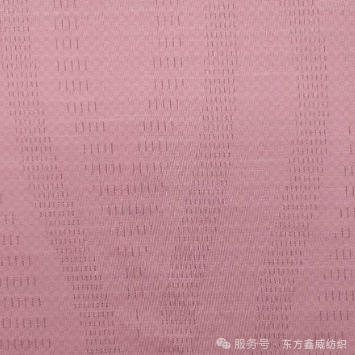
All fabrics below are produced on computerized circular knitting machines with electronic needle selection. Custom patterns, colorways, and functional finishes are available on request.
Style No. | Composition | GSM | Width | Positioning |
J-SPS367 | 100% Polyester | 160–170 | 160cm | Classic all-rounder — best cost-performance ratio |
J-SPS568 | 100% Polyester | 150–160 | 165cm | Ultralight summer variant — ideal for running vests |
SPS-234 | 100% Polyester | 150 | 183cm | Extra-wide width — maximizes cutting efficiency |
J-SPS365 | 100% Polyester | 155–165 | 165cm | Mid-weight — four-season versatility |
J-SPS610 | 100% Polyester | 210 | 192cm | Heavyweight — structured drape for premium tees and polos |
SNS-236 | 73% Nylon / 27% Spandex | 220 | 155cm | High-compression — luxury hand feel for yoga and shapewear |
JC-JAXH-188 | 58% Cotton / 39% Poly / 3% Spandex | 210 | 140cm | Cotton-touch hybrid — casual-to-active crossover |
A frequent buyer concern: does jacquard texture interfere with functional finishing? The answer is no — jacquard knit is fully compatible with the following treatments, and the textured structure often amplifies the finish's effectiveness.
Finish | Compatibility with Jacquard | Performance Note |
Moisture Wicking | Fully compatible | Grooved texture accelerates lateral spread — faster wicking than flat knit |
Cooling Touch | Fully compatible | Q-max >= 0.15 W/cm2 achievable. Structural cooling + finish delivers combined effect |
UPF 50+ UV Protection | Fully compatible | Textured surface increases UV scattering — marginally better protection than flat knit |
Anti-Bacterial / Ag+ | Fully compatible | No interference from jacquard structure; AAA-grade achievable |
Brushed / Peached | Compatible on reverse side | Recommended for autumn/winter tracksuit variants only |
Key procurement insight: Structural moisture channeling (from the jacquard texture) is permanent. Chemical finishes can be layered on top for enhanced performance. Buyers should specify which properties are must-haves at the RFQ stage so we optimize the base knit + finish combination accordingly.
Q1: Is jacquard knit heavier and hotter than flat knit?
A: No. This is the most common buyer misconception. Jacquard knit construction reduces yarn consumption in the raised zones, so a 150gsm jacquard is actually lighter and more breathable than a 150gsm flat knit. The micro-cavity structure increases airflow by 30–50% at the same weight. Summer-weight jacquard (150–160gsm) is our top-selling category for tropical markets.
Q2: Will the pattern fade, crack, or peel over time?
A: Never. The pattern is the fabric structure — not a surface coating. Unless the fabric itself is physically torn, the pattern remains intact. This is a fundamentally different durability profile from printed textiles, where ink degradation is inevitable after repeated washing.
Q3: Can I order custom jacquard patterns for my brand?
A: Yes. We accept custom pattern briefs — from subtle geometric textures to brand-signature all-over designs. The process: pattern design and sampling (typically 2–3 weeks), lab dip approval, then bulk production. MOQ for custom patterns is 1,000 kg per design. For existing in-stock patterns, standard dyeing MOQ applies: 500 kg per color.
Q4: What are standard lead times?
A: In-stock greige + standard dyeing: 15–20 days. Custom pattern development: add 2–3 weeks for sampling and approval. Functional finishing: add 3–5 days. We support partial shipment for large orders.
Q5: Does Spandex-blend jacquard lose elasticity after washing?
A: Not with proper material selection. Our jacquard knits with Spandex use premium elastane filament and optimized heat-setting. After 50 standard wash cycles, elastic recovery remains above 90%. We recommend cold-water wash and shade-drying to maximize Spandex service life.
Q6: Which fiber composition should I choose?
A: Refer to the Decision Matrix in Section 3. Quick summary: 100% Polyester for volume, speed-to-market, and team-wear. Nylon-Spandex for premium yoga/compression positioning. Cotton-Poly-Spandex for lifestyle-crossover brands that want cotton-like hand feel with technical performance.
Q7: Can jacquard knit handle screen printing, heat transfer, and embroidery for brand logos?
A: Yes — but technique must match elasticity. For 100% polyester jacquard (low mechanical stretch): standard screen printing and embroidery work well. For nylon-spandex jacquard (high stretch): use elastic ink or high-stretch heat-transfer film to prevent cracking. Embroidery is safe across all variants. Request our decoration compatibility sheet when placing orders.
Fujian East Xinwei Textile Technology Co., Ltd. operates a fully integrated production base in Sanming, Fujian Province, spanning 83,000 square meters with 400+ circular knitting machines — including dedicated computerized jacquard-knit lines. Our subsidiary, Fujian Naqi Textile, handles in-house dyeing and finishing with a monthly capacity exceeding 3,000 tons.
Certifications: GRS (Global Recycled Standard), ISO 9001, OEKO-TEX Standard 100.
Export coverage: Products shipped to 50+ countries, with established supply chains across Asia, North America, and South America.
Fuzhou Fangtuosi Textile Materials Ltd. manages international trade operations — from sample dispatch to bulk logistics.
In a market flooded with printed polyester basics, jacquard knit fabric is a structural upgrade that your customers can see and feel. It is not a marketing story layered on top of a commodity textile — it is a fundamentally different material with verifiable advantages in breathability, durability, and perceived quality.
At East Xinwei, we do not just sell jacquard fabric by the roll. We help brands select the right fiber base, the right functional finish stack, and the right pattern identity — then deliver it on time, at scale, with full certification traceability.
[Request jacquard fabric samples and technical data sheets →]
Fujian East Xinwei Textile Technology Co., Ltd. Precision-Engineered Jacquard Knit Fabrics for Premium Sportswear. GRS · ISO 9001 · OEKO-TEX Standard 100 Certified. Contact: Fuzhou Fangtuosi Textile Materials Ltd. — International Trade Division.