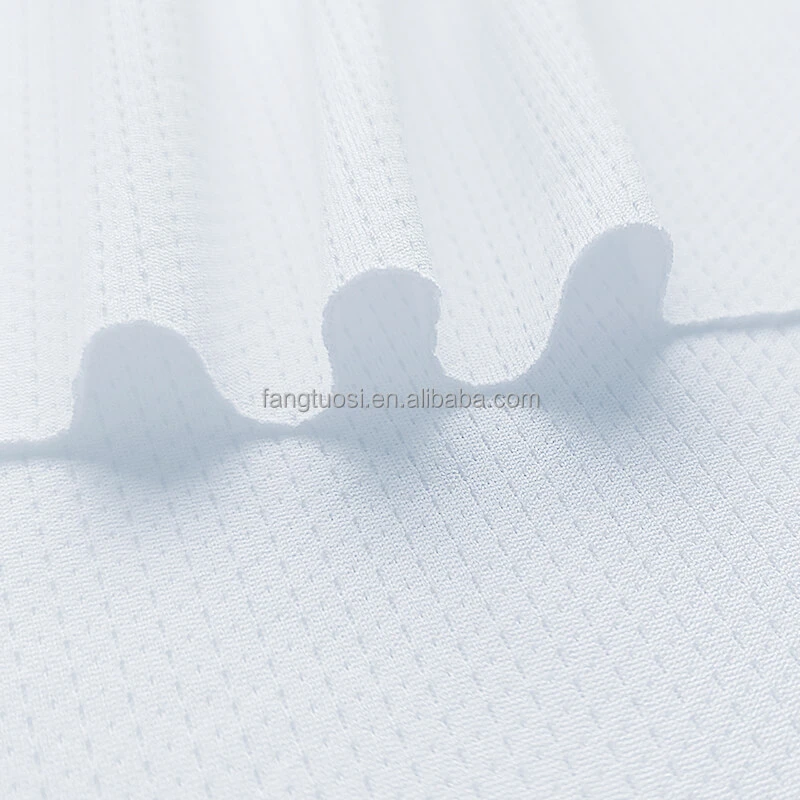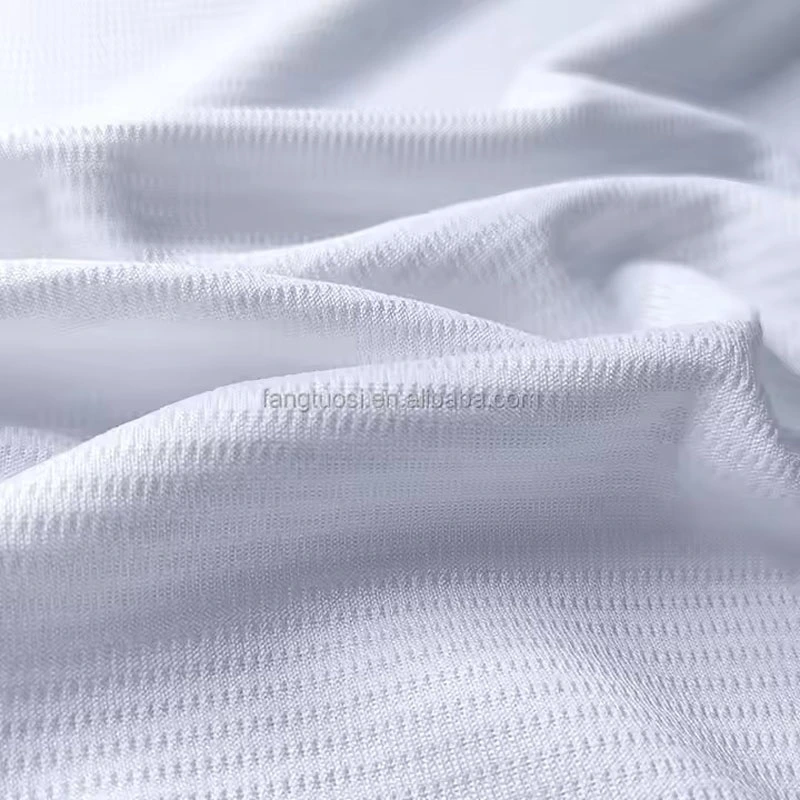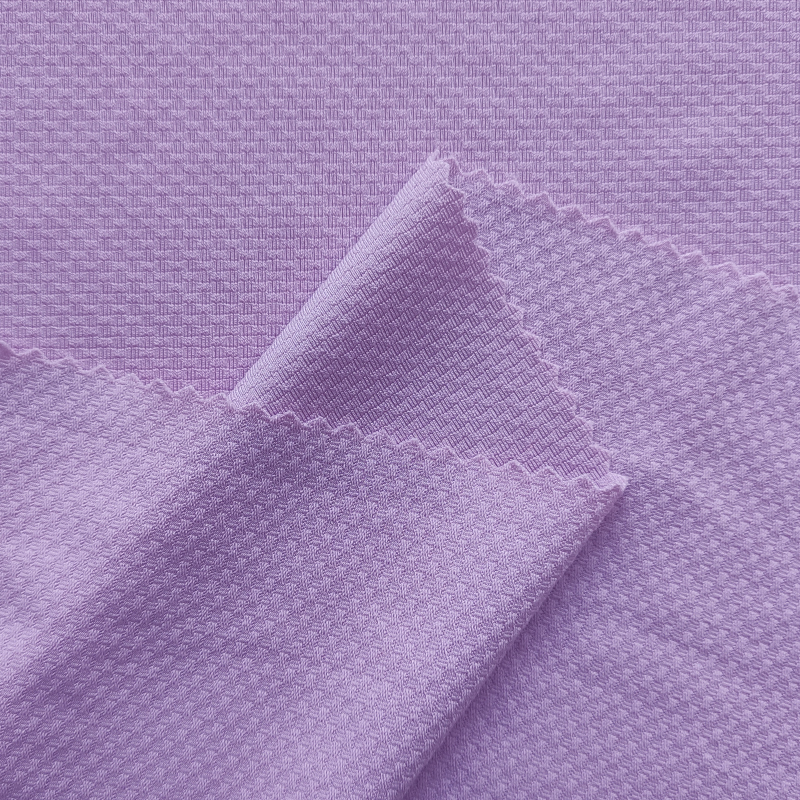
Specialty recycled fabrics let a sportswear brand differentiate on texture, certification scope and processing compatibility — not just on recycled content. Seven styles cover the range: RB01 (50% recycled polyester / 50% bamboo, 130gsm), E081 (92% recycled polyester / 8% spandex, 180gsm), EY-2-R183 (100% recycled polyester mini eyelet, 160gsm × 183cm), HRM04 (78% recycled polyester / 22% spandex, 250gsm × 150cm, peached), R-DN02 (76% recycled nylon / 24% spandex scuba, 165gsm), R0306 (50% recycled / 50% virgin polyester birdseye, 145gsm) and E014 (100% recycled polyester interlock, 300gsm). This guide maps each style to the decision it solves — recycled content level, GRS certification scope, sublimation compatibility, functional finishing and cost — so buyers can shortlist on facts rather than on the word "recycled".
Most recycled fabric articles explain what recycled polyester is. Buyers already know. What they cannot find is an answer to three commercial questions:
● How much recycled content do we actually need? 100% for a sustainability-led line, or 50% blend where certification still holds and cost stays workable.
● Will the certification cover our claim? Recycled content ratio, certification scope, and the transaction certificate that proves it.
● Can we process it? Whether the style accepts sublimation, what functional finishes are compatible, and where heat damages the fibre.
This guide is organised around those three questions. Composition and weight matter, but they only matter once the commercial question is settled.
Note on sourcing: certified recycled fibre is traded with chain-of-custody documents — the certifying scope and the transaction certificate matter as much as the fibre itself.
One table, organised by the problem each style solves — not by a product list:
What you need to solve | Style | Key parameters | Why it fits |
Natural antibacterial + sensitive-skin comfort | RB01 | 50% recycled polyester + 50% bamboo, 130gsm × 160cm | Bamboo brings inherent antibacterial and odour control; light weight suits hot climates |
Design-led texture with gentle stretch | E081 | 92% recycled polyester + 8% spandex, 180gsm × 160cm | Babys-breath mesh pattern; 180gsm gives opacity and structure |
Fine texture, wide-width cutting, full-surface print | EY-2-R183 | 100% recycled polyester, 160gsm × 183cm | Mini eyelet reads almost like a plain surface; 183cm width lifts cutting yield |
Body-contact stretch with a soft brushed hand | HRM04 | 78% recycled polyester + 22% spandex, 250gsm × 150cm, peached | Highest spandex band in the range; 250gsm sits in the leggings / sports-bra band |
Premium sheen and nylon-level strength | R-DN02 | 76% recycled nylon + 24% spandex, 165gsm × 150cm | Recycled nylon: lighter, softer, higher abrasion resistance, scuba structure |
Recycled claim at controlled cost, at volume | R0306 | 50% recycled + 50% virgin polyester, 145gsm × 165cm | Classic birdseye texture; half-recycled recipe balances claim and budget |
Heavyweight structure for outer layers | E014 | 100% recycled polyester, 300gsm × 160cm | Interlock structure, series-high weight, strong drape and shape retention |
Specification: 50% recycled polyester + 50% bamboo, 130gsm, 160cm width.
The only style in the range that blends bamboo rather than staying fully synthetic. Bamboo is a cellulose fibre with inherent antibacterial, bacteriostatic and odour-control behaviour, and a hand feel closer to cotton than polyester. The recycled polyester component supplies strength, quick-dry behaviour and wrinkle resistance.
Where it wins: summer T-shirts, vests, yoga tops, base layers for sensitive skin, childrenswear.
Processing note: high bamboo content means avoiding high washing temperatures and strong alkali — this protects the fibre, not the polyester.
Specification: 92% recycled polyester + 8% spandex, 180gsm, 160cm width.
A fine, evenly distributed floral mesh — visually more refined than a standard birdseye. Two things distinguish it commercially: spandex is uncommon in recycled mesh, and 180gsm provides opacity that lighter recycled meshes cannot offer.
Where it wins: women's T-shirts, vests, yoga and athleisure lines, lifestyle crossover pieces.
Processing note: the 8% spandex content is the constraint for sublimation — treat it as a print-method decision, not a fabric decision.
Specification: 100% recycled polyester, 160gsm, 183cm width.
Mini eyelet holes are smaller and denser than standard birdseye: at a distance it reads as a plain surface, up close the fine aperture structure appears. This delivers ventilation without the transparency risk of open mesh. Two commercial advantages: 183cm width improves cutting yield on large sizes and nested lays, and 100% polyester composition makes it fully sublimation-capable.
Where it wins: team and club kit, event and corporate sportswear, large-surface printed garments.
Processing note: the fine surface holds print detail cleanly — no ink drop-out across large apertures.
Specification: 78% recycled polyester + 22% spandex, 250gsm, 150cm width, peached (brushed) finish.
The highest spandex band in the recycled range, paired with a 250gsm weight that sits squarely in the leggings and sports-bra band, and a brushed surface for a soft hand. This is the style that decides whether a recycled legging or sports bra can match the stretch recovery and skin feel of a virgin-fibre equivalent.
Where it wins: leggings, sports bras, compressive training layers, yoga bottoms.
Processing note: at 22% spandex, high-temperature drying and prolonged sun exposure accelerate elastane ageing. Heat management in the laundry is the single biggest factor in service life for this style. Large-area sublimation is not suitable at this spandex level.
Specification: 76% recycled nylon + 24% spandex, 165gsm, 150cm width.
The only recycled nylon style in the range. Recycled nylon is lighter, softer and more lustrous than recycled polyester, with higher strength and abrasion resistance; typical feedstock includes recovered fishing nets and industrial nylon waste, which is why recycling cost — and therefore positioning — sits above polyester. The scuba double-face structure gives a dense, elastic hand with a smooth surface.
Where it wins: premium yoga, sports bras, swimwear, surf, cycling and designer-led activewear lines.
Processing note: nylon absorbs more moisture than polyester, so quick-dry performance is slightly lower while skin feel and lustre are higher. Choose it when the brief says premium, not when the brief says fastest-drying.
Specification: 50% recycled polyester + 50% virgin polyester, 145gsm, 165cm width.
The commercial middle ground. A half-recycled recipe lets a brand carry a recycled-content claim where a 100% recycled specification is not affordable — most relevant for large team, event and promotional programmes. Birdseye remains the most universal mesh texture in sportswear.
Where it wins: volume team kit, event apparel, training tops, cost-sensitive programmes.
Critical note: certification scope for a 50% blend is not identical to a 100% specification. Confirm with the mill which claim the certificate supports and what ratio is documented before printing anything on the label.
Specification: 100% recycled polyester, 300gsm, 160cm width.
The heaviest style in the range. Interlock knits are denser than single jersey and identical on both faces — no face or back to track in cutting. At 300gsm the fabric holds shape and drape, which is what outer layers and structured silhouettes require. Being 100% polyester, it is also fully recyclable at end of life and fully sublimation-capable.
Where it wins: tracksuits and warm-up sets, training jackets, team walk-out wear, outer-layer panels.
Processing note: 300gsm is an outer-layer weight — it is the wrong choice for high-intensity summer wear.
No — provided the feedstock and the mill are controlled. Recycled polyester (rPET) is produced by washing, shredding, melting and re-spinning recovered PET, so the polymer structure matches virgin polyester and the key indicators (strength, elasticity, abrasion, colour fastness) sit at the same level. Two caveats: feedstock quality and washing standards affect the final fibre, and recycled yarn uniformity is usually slightly behind virgin fibre at very fine deniers. Both caveats are managed by supplier selection, not by avoiding recycled fibre.
GRS — the Global Recycled Standard, administered by Textile Exchange — verifies recycled content across the supply chain: feedstock origin, traceability in production, and the recycled ratio in the finished fabric, checked by a third party. It also sets a minimum recycled content threshold of 50%. For brand owners this is the legal basis for a recycled claim: without third-party verification, a "recycled" label is exposed in regulated markets. Certified supply also comes with a transaction certificate documenting the specific batch.
Qualified recycled polyester withstands 50+ standard washes without visible distortion, fading or mesh breakage. The variables are the same as for virgin fabric: fibre quality, knit density, dyeing and finishing, and the laundering regime. For spandex-containing styles, keep wash temperature below 40°C, avoid high-temperature tumble drying, turn garments inside out and use a laundry bag. Elastane ageing under heat — not the recycled content — is what shortens service life.
Yes, with identical processing to virgin fabric. Quick-dry comes from the hydrophobic nature of polyester, and can be pushed further with a moisture-wicking finish or a modified wicking fibre. Antibacterial options differ in durability: silver-ion finishes typically decline after 20–30 washes, while inherently antibacterial fibres such as bamboo behave more durably (the RB01 rationale). UPF 50+ is achieved by UV-absorber finishing or by dense construction. One genuine constraint: some finishes and auxiliaries sit awkwardly with the environmental requirements attached to recycled certification — confirm the finishing route and its certification compatibility before bulk.
Typically 5%–15% above an equivalent virgin specification, a gap that has been narrowing as global recycled fibre capacity scales; some high-volume recycled polyester specifications are already close to parity. The gap comes from feedstock collection and washing, certification and testing overhead, and lower efficiency on small recycled lots. For brands selling into regulated or sustainability-sensitive markets, recycled content is closer to an access requirement than an upgrade. For cost-driven programmes, a 50% blend such as R0306 is the pragmatic route.
100% recycled polyester can, with the same colour intensity and fastness as virgin polyester — the chemistry is identical. Three cases need a different print route: recycled styles containing spandex (not suitable for large-area sublimation because of heat exposure), and nylon or bamboo blends, where the printing only takes on the polyester portion and leaves the other fibre undyed — use reactive printing or digital direct printing instead. On very pale shades, sample first: trace impurities in recycled fibre can affect dyeing uniformity at the lightest end.
Before committing volume on any of the seven styles, confirm: shade consistency across lots (especially pale colours), pilling performance after the intended finish, logo and print adhesion on the chosen texture, and lot-to-lot hand-feel consistency. These four items account for most bulk disputes on recycled programmes.
Step 1 — Fix the garment and the recycled-content target. Leggings and sports bras point to high-spandex styles (HRM04); T-shirts and vests point to mesh or jersey; outerwear and sets point to heavyweight interlock (E014). Then decide the content level: 100% recycled for a premium line, 50% blend where volume and cost dominate.
Step 2 — Define the functional requirement. Natural antibacterial and skin comfort → bamboo blend (RB01). Brushed, soft skin contact with high stretch → HRM04. Premium lustre and nylon strength → R-DN02. Fine, low-transparency texture → EY-2-R183 or E081.
Step 3 — Lock certification and print method. Confirm the certificate scope and transaction certificate before the claim is designed into packaging. Select 100% recycled styles where large-area sublimation is planned; move spandex and blend styles to screen or digital direct printing.
Step 4 — Sample two or three candidates. Parameters filter, samples decide. Compare hand feel, stretch recovery, shade and finish performance across at least two candidate styles before committing.
The differentiator in recycled sportswear has moved from "contains recycled fibre" to "which recycled fibre, certified to what scope, and processable in what way". RB01 solves comfort and natural antibacterial performance, E081 and EY-2-R183 solve texture and print detail, HRM04 solves stretch and skin contact, R-DN02 solves premium hand and durability, R0306 solves the volume-scale cost equation, and E014 solves structure in outer layers.
Choosing among them is a product decision before it is a sustainability decision — and it determines which markets the garment can enter and what the brand can credibly claim on the label.